Wednesday, April 15, 2009

News Report #5

All-in-one Nettops resurrecting desktop market


By Erica Ogg


4/15/09


There seems to be a new category of computer that all the name brand PC manufactures are competing in called All-in-one PC or "Nettops". These PC's are designed specifically with price in mind, with small screens usually fifteen to nineteen inches wide, And small inexpensive processors. Most experts didn’t think that the “Nettops” would start to impede on the Notebook market, but that seems to be what is happening. Ever since the stock market plunged no one can afford to by a Fifteen hundred dollar Apple iMac. That is why they believe that these new kinds of all-in-one PC’s will sell very well in stores like Target, Wal-mart and Costco, because they are all in one box and have no need to buy expensive accessories.
The reason I picked this news article was that I believed that it was relevant to the lecture we had the other day on the digital divide. This new type of PC seems to be more affordable than previous years. With these PC’s being priced at three to four hundred dollars, rather than in the thousands, I feel that It breaks down the digital divide significantly. Now all someone has to do is figure out a way to provide inexpensive internet access to lower income families. This is definitely one big step closer to bringing down the digital divide.


Wednesday, April 1, 2009

News Report #4


Facebook Takes a Dive: Why Social Networks Are Bad Businesses

By 24/7 Wall St.


Social networking giants, Myspace and Facebook may not be living up to what the advertising sector was hoping. Reports are that these two sites are not generating the advertising revenue that predicted. Myspace a few years back was purchased by newscorps in a attempt to make a huge profit off of the 100 million users that current use it to communicate with their friends. It was not anticipated that while these users were socializing with friends that they would not be interested in things being advertised. It is unlike a site that specifies in one kind of product, like “shoes”. Where an advertiser would know that the person is their to specifically look for shoes.
There have been many financial roomers spreading throughout Facebook that I have experienced in first person. One has to deal with how Facebook had recently changed its user policy so that all content that users put on the site would be the property of Face book, with which they could do what they want with it. This opens the door for Facebook to sell the information that the users post on the site to a 3rd party company that in turn would sell it to advertisers. There was a huge out rage to this throughout the Facebook community, mostly because they had changed the user policy without letting its users directly know. In my opinion it is really sad to see these small fun sites turn into advertising giants, it seems to happen to a lot of them.

Monday, March 23, 2009

Reading report #5

3/22/09


This article, I can really relate to. All throughout high school and my first semester at UNCW I had no clue about the differences between a Internet source and a scholarly journal. In high school I would use sources and not even bother to check there authenticity. I had never been taught how to search through information on the internet, I was just told to do the paper or worksheet by my teachers. So when I read this article I completely agreed with it. It is truly a challenge trying to decipher sometimes, if a web site can be trusted or if the information is even relevant.
This article informed me of the ICT Literacy Assessment, which is a 75 minute test offered at 2 difficulty levels in the subjects of organizing, evaluating, and communicating with electronic data. This test proved that 48% of Cal State students who took the test failed. This showed that the students were not able to do research on a college level. This test seems like a great idea to me. In fact I think that high schools need to teach this material to their students and then upon entering college, this test should be administered to all incoming freshmen in the United States. And all students who do not pass must take a class on evaluating research sources in their first semester at college. I know that I would have greatly benefited from a program like that.

Wednesday, February 18, 2009

Reading Report #3

This is a very revolutionary article; I really made me ponder the question “What is the future of libraries?” In this article Frey talks about the evolution of the library and the continuous transitions that they have to go through to keep up with current technology. Including but not limited to; changing written catalog information to electronically based system, and adaptation to the Internet. Another interesting concept that Frey mentioned was the theory that search technology will become increasingly more complicated. His thought is that searching text will become obsolete, and that more advanced searches will include; taste, smell, texture and even speed or volume. One of the last points that Frey makes in his article is that libraries will change from places of information to places of community culture. Libraries will be transformed into a place that a community can go to learn about their culture, much like a museum.
In my opinion libraries are going to go through a major change in the way they store their information. I believe that the book is going to become a thing of the past and that most libraries will switch over to a computer data bank system. One of the major statements that people make against this is that “reading off a monitor hurts their eyes, ” but I believe that with technology that we will overcome that obstacle. I think that this will all happen within the next 30 years, but the change will be very suttle and gradual.

Monday, February 16, 2009

News Report #3


For many Chinese, literary dreams go online
by Lara Farrar
http://http//www.cnn.com/2009/SHOWBIZ/books/02/15/china.publishing/index.html?eref=rss_tech


2/15/09


This report is about a man in china named Murong Xuecun, Formally a sales manager for a major car company in China. On the side Murong wrote a story on modern urban life, which made its way onto many online forums. His work has become so popular that it has even been featured on T.V. in 3 different languages. Many people view him as a pioneer of the most resent online literary renaissance. More and more Chinese writers are using the Internet to get their messages out. An example of this is Shanda Literature operates three of China's biggest online literature site that receive more than 200 million page views a day. They own the rights to more than 200,000 works.Publishers have started a new wave of looking for their new up and coming writers on the web. Bookstores now have sections devoted to Internet novels published as paperbacks Hopefully this revolution will further liberalize the Chinese publishing industry.
I think that this is a very good thing for China, and the Chinese people. The Chinese government has always been very strict on individual expression. Hopefully this online revolution will bring together writers of not only China but of the entire world to a central place called the Internet. The web has really changed how we view authors because anyone can now write something and put it on the web for anyone in the world to see. In my opinion, This might lead to a new wave of plagiarism, because it makes it easier to “copy” and “paste” stories together.

Wednesday, February 4, 2009

News Report #2


http://www.cnn.com/2009/TECH/02/04/google.latitude/index.html


CNN.com / By Stephen Shankland

2/4/09

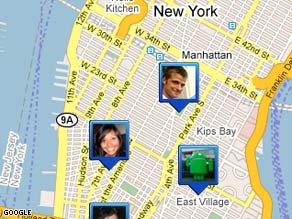
Google has just launched a branch of new software that can track any of your friends mobile phones to precise locations, They hope that users will take full advantage of this software to keep in touch with their friends and relatives. For “Latitude” to work, all parties must set up their cell phones with the program. Google has incorporated many features into this new software, it lets you essentially “hide” where you are at or even set any location you wish for people to see. What Google intends to get out of this software is location based advertising. Google claims that it works in over 27 countries and will work on any blackberry, (and iPhone very soon). It works by determining your position from 3 separate sources which are, GPS, cell phone towers and even wireless networks.

I personally see no reason anyone would want this kind of software, I think that it is an invasion of privacy. I for one would not like my friends to know where I am 24/7. When I get a mental image in my head of who would be using this, I think of some overzealous husband, tracking his wife’s every movement. With the features that Google has included, it not even good for that. The only possible application I see for this software is with employers and employees, possibly delivery drivers. Google has come out with a lot of neat stuff lately but I think that this just crosses the line, the line of privacy.

Sunday, January 25, 2009

Reading Report #1

1/25/09

There are many things that I have learned from this first reading in lib 103. I had no idea that there were so many different types of mischief on the Internet. Like counterfeit websites disguise that themselves as legitimate sites for a purpose of releasing misinformation. And disinformation web sites which release of known false information with the intention of influencing the people that receive it. I am very interested to view the work of theses many counterfeiters. I found it very intriguing how most of these people use information as a weapon. A weapon they use to fight for their cause, whether or not the information is true is irrelevant, as long as the public believes it. I personally had no clue that you could “hijack” a website until I read about in this article. When a website is hacked, the contents of it are changed or even redirected to an unwanted site. A lot of scams happen after a major disaster or event, usually they are sent though e-mail and request for you to make a donation to a charity. There are a number of ways you can avoid scams like this including

- Only deal with the charity sites directly.
- Only donate to well known organizations.
- Most charity sites do not send out e-mails asking for money.
- Check the URL address; make sure you are where you think you are at.

I have actually fallen prey to a Phishing web site before. It was about 2 years ago when myspace had a break in security and I accidentally gave away my password thinking I was at myspace.com and the hackers wiped my account clean, but before that they sent credit card scams to all my friends list. Myspace had to delete my account and I had to start over.